What is a call answering service, and which kind does a small business need?
A call answering service (or phone answering service) answers your business calls when you can't, in your business's name, and sends you each caller's details; small businesses choose between a live human service, a virtual receptionist, an AI answering service and plain voicemail, depending on how complex their calls are.
Free tool: put your own call numbers into the missed call cost calculator to see the bookings and revenue lost each week, month and year.
What a call answering service does
Every call answering service does the same basic job: it picks up the calls you can't, so the caller speaks to someone (or something) instead of ringing out or hearing a beep. It answers with your business name, deals with what it can, and sends you a message with the caller's name, number and what they need.
"Call answering service", "phone answering service" and "telephone answering service" mean the same thing. The real differences are who or what answers, how much they can do on the call, and how you pay. For a small business the main question is usually not whether to have one, but which kind fits the calls you actually get.
The four kinds, and what your callers hear
Most options fall into one of these groups:
- Live answering service: a person in a call centre answers for many businesses, following a script you give them. Callers get a human voice. It's good with unusual or emotional calls, but the person rarely knows your prices or diary in detail, and out-of-hours cover can cost more.
- Virtual receptionist: a smaller team of people who get to know your business better, often able to book appointments into your calendar. It's closer to having your own receptionist, and usually priced higher than a basic live service.
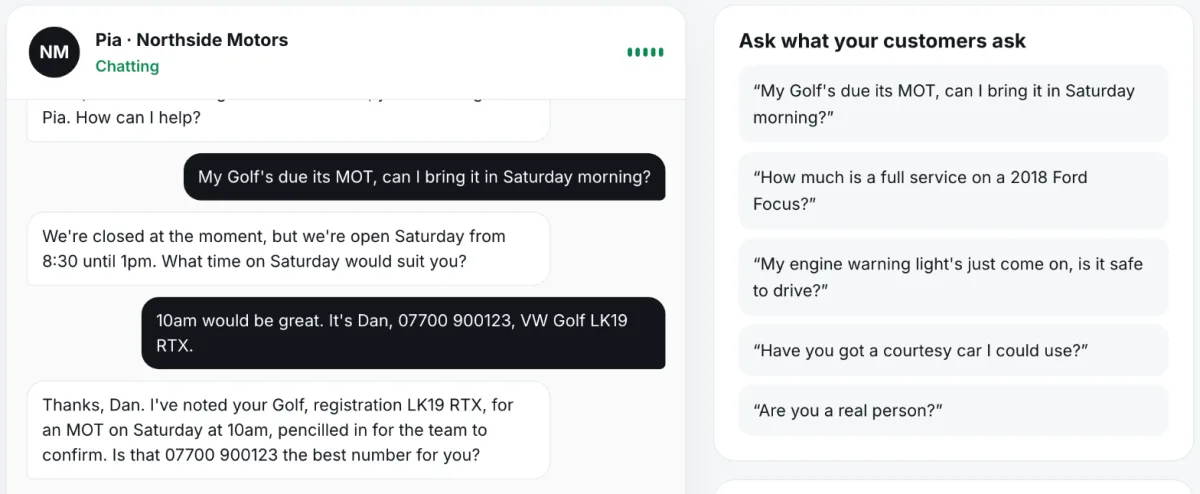
- AI answering service: software that holds a spoken conversation, answers questions from your own details, takes the caller's information and can offer a booking time. It answers at any hour for the same price and handles routine calls consistently, but it isn't the right choice for calls that need human judgement on the spot.
- Voicemail or auto-attendant: a recorded greeting, sometimes with a menu of options, that records a message. It's the cheapest, but many callers hang up rather than leave a message, and you still have to call everyone back to find out what they wanted.
AI or a human answering service: an honest comparison
Cost: a human service pays people to answer, so it's usually charged per call or per minute at a higher rate, often with extra for evenings and weekends. An AI service costs the same at 3am as at 3pm. For routine calls AI is normally cheaper; for a handful of long, complicated calls a month the gap is smaller.
Cover: an AI service answers around the clock for the same price. Human services can offer 24/7 cover, but check whether nights and bank holidays are included in the price you've been quoted.
Judgement: a person copes better with an upset customer, a complaint or a muddled story. AI is best at the predictable calls (prices, hours, availability, bookings) and should take a message for anything else.
Putting calls through: many human services can transfer an urgent call to your mobile while the caller waits. Not every AI service can. Pickuply puts urgent calls through to your mobile after taking the caller's details, and marks them urgent in the email summary if you miss it. If live transfer matters to you, ask every service before you choose.
How calls reach the service
You don't need a new phone system. You keep your number and set a divert to the service's number. Most small businesses divert only calls they don't answer ("divert when not answered"), so their own phone still rings first. On a UK mobile that's usually a short code; on a landline or business phone system it's a setting with your provider.
You can also divert when you're busy, outside opening hours, or all the time. You only pay for the calls that reach the service.
What it costs
Services charge per call, per minute or as a monthly bundle, often with extras for set-up, evenings and weekends, or going over your allowance. Our guides on how call answering services are priced and on per-minute versus per-call pricing go through each model and the hidden extras. Whatever the price, start from your own numbers: count the calls you miss in a normal month and how long they last.
Then set that against what the missed calls are worth. If a few of those callers would have become jobs, the service usually pays for itself; the missed call cost calculator does the sum with your own figures.
A checklist for choosing one
Before you sign up, check:
- Can I hear it answer a call for my business before I pay or give card details?
- Does it know my real prices, hours and services, and can I correct it?
- What happens when it doesn't know the answer?
- Can it book appointments, or only take messages?
- How quickly do messages reach me, and in what form?
- Can it put urgent calls through to me live, or only flag them?
- Is there a contract, a set-up fee, or a charge for evenings and weekends?
- Are calls recorded, and how long is caller information kept?
Step by step
- Count your missed calls. Check your phone's call log for a normal month: how many calls went unanswered, and when.
- Decide what the service must do. Take messages only, answer questions, or book appointments too.
- Shortlist and test. Call each option as if you were a customer, including a question it shouldn't know the answer to.
- Set the divert. Divert unanswered calls to the service so your phone still rings first.
- Check the first week. Read every message, correct what it got wrong and call back anything urgent first.
Where Pickuply fits
Pickuply is an AI answering service for UK small businesses. You paste your website or Google listing, check the hours, services and prices it writes up, and call it in your browser before paying anything. Then you divert the calls you miss and keep your own number. It answers in your business's name at any hour, offers free times for bookings for you to confirm, marks urgent calls, and emails you a summary straight after each call. It doesn't put calls through to your mobile live. Starter is £39 a month for 150 call minutes (then £0.30 a minute), and Pro is £89 for 400. Both come with a 14-day free trial and no contract.
Free to try on a call in your browser. No card needed. Or start without a website, or hear a sample call first.
Questions
Is a phone answering service the same as a call answering service?
Yes. Call answering, phone answering and telephone answering service are different names for the same thing: someone or something answers your calls when you can't and passes on the message.
Do I need to change my number?
No. You keep your number and divert calls to the service. Most small businesses divert only the calls they don't answer.
Will callers know it's an answering service?
A live service usually answers as if it's your office. A responsible AI service answers in your business's name and says it's an AI assistant if a caller asks; Pickuply does.
Can a call answering service book appointments?
Some can. Virtual receptionists and AI answering services often can; basic message-taking services usually can't. Pickuply offers free times inside your opening hours and holds the booking for you to confirm.